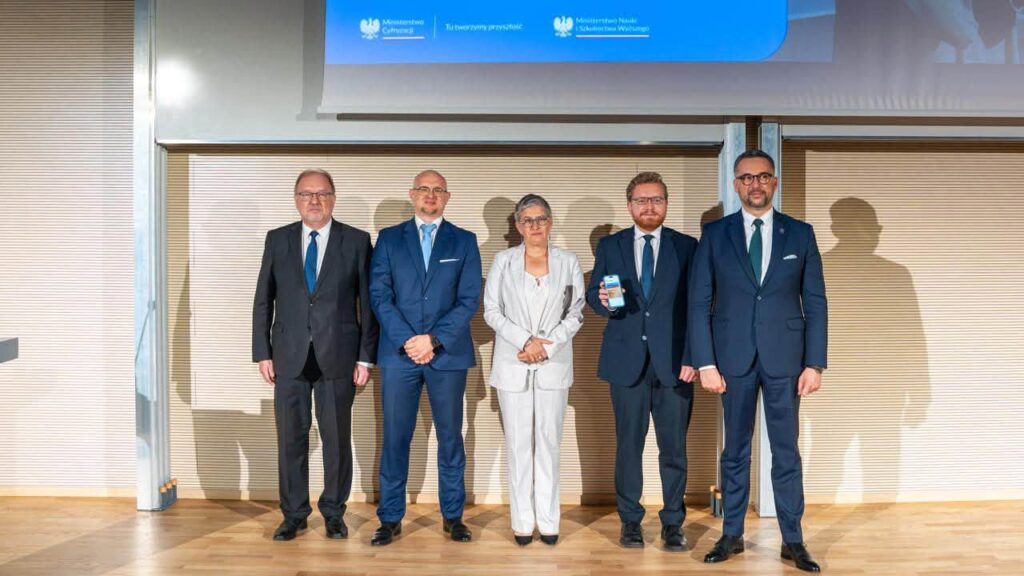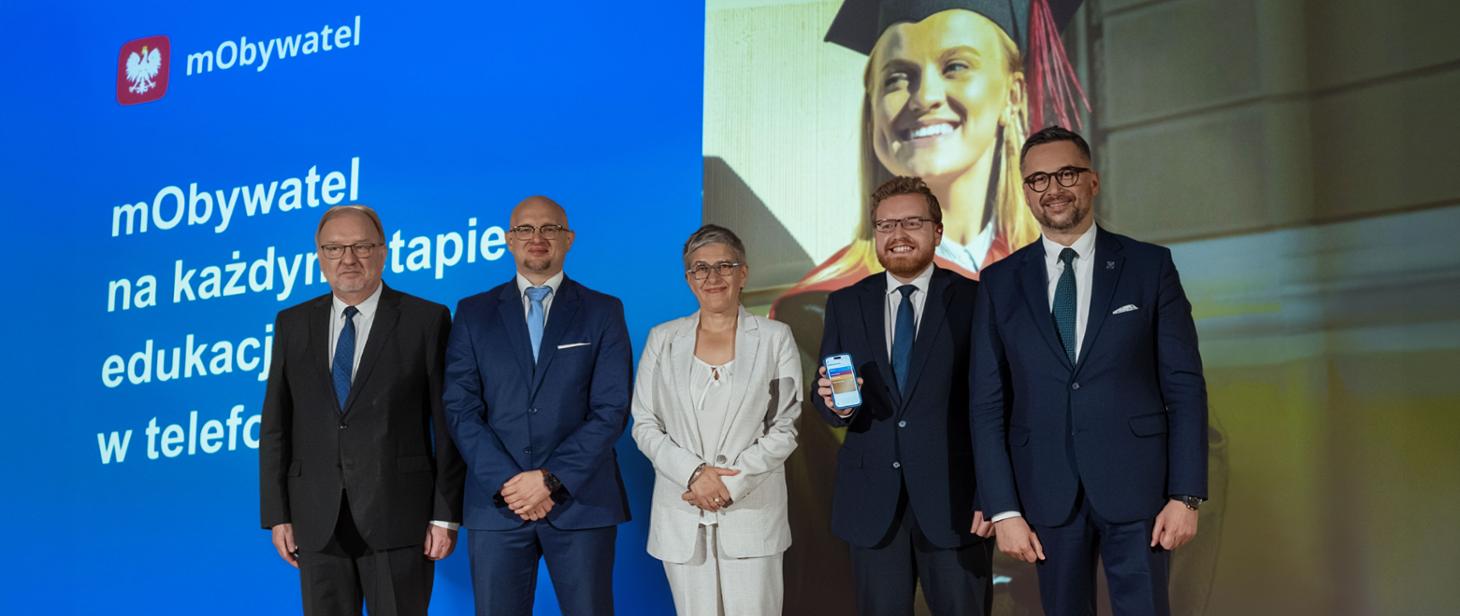
HEIs in Poland can now issue digital diplomas that graduates can access via the mObywatel application. Equivalent in legal effect to traditional paper documents, digital diplomas will become the default format for higher education credentials starting from 1 January 2027. The solution was jointly developed by the Polish Ministry of Digital Affairs (MC), the Polish Ministry of Science and Higher Education (MNiSW), and the National Information Processing Institute (OPI PIB).
The digital diploma: A new standard in higher education
‘Today marks the rollout of digital diplomas in mObywatel, offering graduates a secure and readily accessible document. It also enables employers to easily verify the authenticity of diplomas,’ says Dariusz Standerski, Vice-Minister of Digital Affairs.
Digital diplomas are legitimate source documents authenticated with an electronic signature and an electronic seal, and are distinct from paper diploma scans. With digital diplomas available on mobile devices, graduates can confirm their educational achievements anywhere and at any time, while HEIs and employers gain access to a safe and practical tool designed for issuance and verification of documents.
The digital diploma is available to students in the mObywatel application and on the dyplomy.nauka.gov.pl website.Graduates can also download their diplomas, supplements and copies thereof (if such are issued by their HEIs) in the PDF format.
Benefits to HEIs and employers
Digital diplomas offer numerous benefits to HEIs. HEIs gain access to an intuitive cutting-edge tool designed to issue documents that reduces printing, storage and administrative costs. In addition, it improves both the security and credibility of issued diplomas.
Employers benefit from a no-cost tool enabling rapid verification of academic credentials. The solution helps them authenticate applicants’ qualifications, mitigates the risk of dealing with forged documents, and streamlines the recruitment process.
The Polish National Repository of Electronic Diplomas: The backbone of the new system
The issuance of digital diplomas is supported by the Polish National Repository of Electronic Diplomas (RDE), which is part of the POL-on system. The repository enables issuance, sharing, verification, and archiving of digital diplomas.
‘In my view, the introduction of digital diplomas in Poland has been one of the most impactful advancements in the higher education sector in recent years. The Polish National Repository of Electronic Diplomas will offer graduates a secure, sustainable and convenient access to documents certifying their educational qualifications. By ensuring that diplomas issued by Polish universities are secure and easy to verify, this solution reinforces the prestige of Polish diplomas internationally, says Marcin Kulasek, Minister of Science and Higher Education.
Essential information about digital diplomas in mObywatel
- The application supports three types of documents: diplomas of completion of higher education studies (first-cycle programmes, second-cycle programmes, and long-cycle programmes), doctoral diplomas, and habilitation diplomas.
- Digital diplomas are legally equivalent to hard-copy diplomas.
- The RDE enables users to download PDF versions of their diplomas, supplements, and copies thereof in foreign languages if such are issued by their HEIs.
- Digital diplomas will not be issued retroactively. This means that graduates who earned their degrees in previous years will not be able to use the mDiplomas feature in the mObywatel application.
For more information on mDiplomas, visit the mObywatel application website.
Security first
The Polish National Repository of Electronic Diplomas was developed by experts at the National Information Processing Institute. The system streamlines, accelerates, and automates HEIs’ administrative processes without compromising document security.
Each diploma passes a comprehensive verification process, receives a qualified electronic signature from an authorized university representative, and is authenticated with the repository’s qualified electronic seal. This ensures the document is authentic and protected from tampering. The system complies with international cybersecurity standards and relies on regularly updated security mechanisms.
‘The Polish National Repository of Electronic Diplomas combines cutting-edge technology and well-established legal framework. The transitional period will give higher education institutions time for necessary organisational and technical preparations before electronic diplomas become mandatory in 2027, underlines Maria Mrówczyńska, Vice-Minister of Higher Education and Science.
Digital diplomas to become mandatory in 2027
The rollout of digital diplomas started on 30 June 2026. The issuance of electronic diplomas will remain optional for HEIs by the end of 2026. From 1 January 2027, all new diplomas will be issued electronically.
Doctoral ID in mObywatel: Another digital solution for academia
The mObywatel application now also supports the electronic doctoral ID – a digital equivalent to its hard-copy version. With it, doctoral students will join the community of those who can attest their academic credentials with a smartphone.
For more information on doctoral IDs, visit: Doctoral ID – mObywatel.
Click on the video below to discover they key insights of the conference.
#EUFunds
***
Poland’s National Recovery and Resilience Plan (KPO) co-funds the development of the mObywatel application as part of the ‘Expansion of the mObywatel application ecosystem’ project.
The undertaking is funded by the European Union as part of KPO within the framework of Action C2.1.1 – Public e-services, IT solutions designed to improve the functioning of administration and economic sectors.
EUFunds #KPO
For more information, visit the website of the Polish Ministry of Digital Affairs.
The ‘E-Diplomas – the Polish National Repository of Electronic Diplomas’ project is conducted by the Polish Ministry of Science and Higher Education in collaboration with the National Information Processing Institute. The total project value amounts to PLN 33.5 million, of which PLN 30.2 million is funded from the Poland’s National Recovery and Resilience Plan.